
When a Turist Icon Wears Out
1. Semiotic Saturation and the Crisis of the Sign in Contemporary Tourism
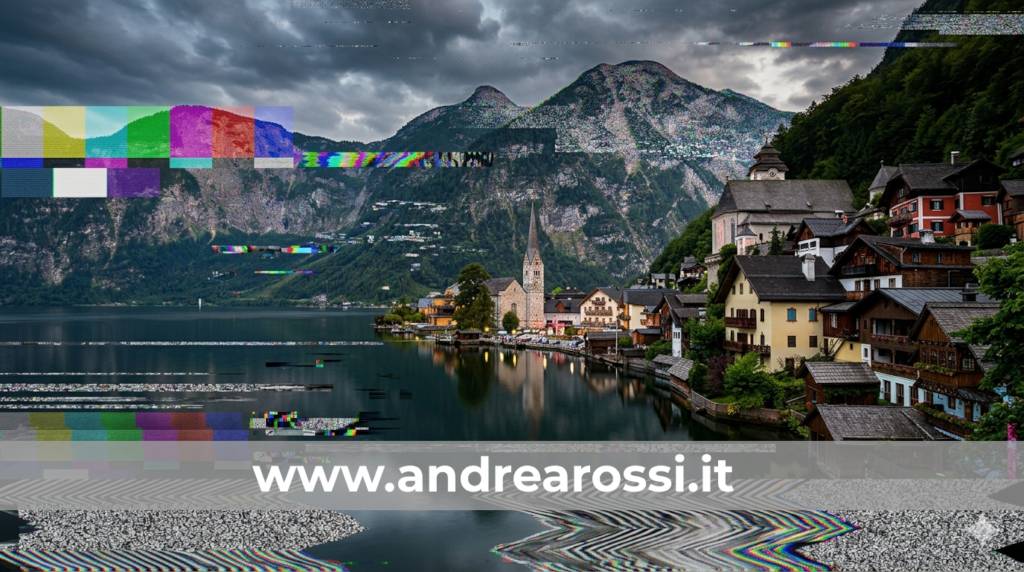
Imagine a small Austrian Alpine village, isolated and peaceful, suddenly overwhelmed by millions of visitors every year and even faithfully replicated in a province of China. This is the story of Hallstatt.
Or think of Maya Bay, the idyllic Thai beach that remained closed for years to allow its ecosystem to recover after being literally overwhelmed by mass tourism triggered by the success of a Hollywood film. These places did not simply become famous. They were transformed into global symbols trapped by their own image.
Yet today, a curious phenomenon is emerging.
Many visitors arrive at these destinations having already seen thousands of photographs, videos, and digital posts. They already know the most famous viewpoints. They know which places to visit, which photographs to take, and which experiences to share on social media.
In some cases, the image of the place seems to precede the place itself.
This situation raises an important question for tourism and destination management professionals.
What happens when a tourism symbol is reproduced, shared, and consumed so many times that it begins to lose part of its ability to surprise?
To understand this phenomenon, we need to return to the idea of tourism as a system of meanings.
2. When Success Becomes Repetition
In the previous articles in this series, we explored how a place can become a tourism symbol and how certain sites are gradually sacralised until they become mandatory stops within the tourist gaze.
We also examined how media and digital platforms contribute to reinforcing and disseminating particular representations.
This process, however, contains a potential contradiction.
The strength of a symbol depends on its ability to condense meanings and distinguish itself from competing signs. Yet when that same symbol is continuously replicated, photographed, and reproduced, it gradually risks losing part of its uniqueness.
This does not necessarily mean a loss of popularity.
In fact, the opposite is often true.
The destination remains highly visible and continues to attract visitors. What may diminish is its ability to appear new, surprising, or distinctive.
In other words, the problem does not concern the visibility of the sign, but its symbolic vitality.
The case of Hallstatt provides a perfect example of this dynamic. Its colourful houses overlooking the lake and framed by mountains have become one of the most replicated visual templates on Instagram feeds. For years, this image represented the archetype of Alpine idyll and the European fairy tale. Today, however, its constant digital reproduction has transformed a real place into a standardised visual scenario. Visitors do not arrive in the village to discover local culture. They arrive to verify that reality matches the digital postcard they have already consumed hundreds of times online.
The tourism experience thus becomes, at least in part, a confirmation of pre-existing expectations.
3. From the Tourist to the Post-Tourist
Some scholars have described this transformation through the concept of post-tourism.
The idea is not that tourism has ended or that tourists have disappeared. On the contrary, tourism continues to grow. What changes is the relationship between visitors and the representations that circulate around destinations.
For a long time, travel was interpreted as a search for authenticity, discovery, and difference.
In the contemporary era, visitors are often fully aware of the constructed nature of tourism experiences. They know that many images have been selected, curated, and amplified by the media. They understand that certain attractions have become famous precisely because of their continuous reproduction.
Yet they continue to participate in the game.
The selfie on Hallstatt’s panoramic platform or the close-up photograph among the cliffs of Maya Bay no longer serves primarily to document the exploration of the unknown. Instead, it serves to demonstrate participation in a collective ritual and in a visual system that has already been validated by algorithms.
Travel becomes a form of symbolic participation.
This dynamic produces important consequences.
The more an image is shared, the more recognisable it becomes. But the more recognisable it becomes, the greater the risk that it will begin to appear predictable.
The very force that made a destination famous can, over time, contribute to reducing its ability to generate surprise.
4. When a Destination Becomes a Prisoner of Its Own Image
This phenomenon is particularly relevant for destination management.
Many place marketing strategies quite rightly aim to build strong and recognisable symbols. The problem emerges when those symbols become the only elements through which the destination is perceived.
Consider the evolution of Maya Bay.
Within the collective imagination, that stretch of coastline in Thailand became synonymous with the idea of an “untouched tropical paradise”, a narrative fuelled by cinema and amplified endlessly through social media.
This image became so powerful that it generated unsustainable visitor pressure, ultimately leading to the site’s closure.
The semiotic paradox is clear: the relentless consumption of the sign (the idea of a pristine beach) ended up destroying its physical referent (the actual beach).
When communication reduces the richness of a destination to a single visual stereotype, the place loses its ability to generate new meanings and enters a crisis that is simultaneously environmental and identity-based.
In these situations, a destination risks becoming a prisoner of its own symbolic success.
Its popularity remains high, but its capacity to generate new meanings gradually declines.
5. The Role of Digital Platforms
Digital platforms have further amplified this dynamic.
Algorithms tend to favour content that has already demonstrated its ability to generate attention, engagement, and interaction.
As a result, the most popular images are displayed more frequently, while alternative representations struggle to emerge.
This creates a form of self-reinforcing cycle.
Destinations continue to promote the images that perform best.
Users continue to seek them out because they are the images they encounter most often.
Platforms continue to reward them because they generate results.
The outcome is an increasing concentration of attention around a limited number of symbols and narratives.
From a semiotic perspective, this process can be interpreted as a form of saturation.
Not because the symbol ceases to exist, but because its constant repetition gradually reduces its capacity to differentiate itself.
6. What This Means for Destination Management
This perspective suggests several important reflections.
The first is that popularity does not necessarily coincide with symbolic strength.
A destination may be extremely well known and, at the same time, struggle to generate new meanings.
The second concerns the need to continuously nurture the narrative evolution of the destination.
Icons should not be abandoned. They remain fundamental strategic assets. However, it is important to complement established symbols with new stories, new imaginaries, and new interpretative frameworks.
The third concerns the monitoring of digital communication.
Today, digital platforms make it possible to observe in real time which images dominate the narrative of a destination and which remain marginal.
This makes it possible to identify potential saturation phenomena before they become a strategic limitation.
In many cases, the challenge is not to make a destination more visible.
It is to make it interesting again.
Conclusion
In contemporary tourism, the challenge is not simply to build strong symbols.
It is to keep them alive.
The most competitive destinations are not necessarily those with the most famous icons. They are the ones that continuously renew the meaning of their icons without losing their identity and coherence.
Understanding semiotic saturation therefore means understanding one of the central paradoxes of the digital age.
The more a destination is represented, the greater its visibility becomes. But if those representations stop evolving, that same visibility can turn into a form of symbolic weakening.
For this reason, the future of destination branding is not only about creating powerful images.
It is about the ability to generate new meanings around images that everyone believes they already know.
Destinations do not risk becoming irrelevant only when nobody knows them.
Sometimes the risk emerges when they are always told in the same way.
I help destinations, DMOs, tourism organisations, and local ecosystems identify new meanings, new narratives, and new cultural affinities capable of keeping a destination’s identity alive, distinctive, and relevant over time.
If you would like to explore how these themes can support your destination’s strategy, write to me at: hello@andrearossi.it
Leave a Reply
Want to join the discussion?Feel free to contribute!